Sunday, March 29, 2015

Pro Athletes Promote Charities


Being a celebrity has many perks, including the money, fame, and overall opportunities. Because celebrities are so popular and have large fan bases, it is easy for them to get word out quickly to large amounts of people. This celebrity approach has been beneficial for advertising and promotions. But some celebrities and famous athletes aren't all about the attention, and use their fame to help others. Charity work and 'giving back' has become very important in today's society and many people get involved in this practice.

One of the most popular things going around the internet this past summer (2014) was the ALS Ice Bucket Challenge. The challenge included recording a video of you pouring a bucket of ice water over your head and nominated a few of your friends to do the same, upload the video to social media, and nominating new friends, all within 24 hours. If the challenge wasn't complete, they were to donate $10 to the ALS association. This challenge quickly went viral across the nation, as people tagged more and more people.  My university volleyball team was nominated by one of our opponents, Missouri State, to complete the challenge. Check it out by clicking this link:

https://www.facebook.com/video.php?v=931374916889454


Many other famous athletes got involved with the hype:


The best thing about today is that its easy to get news and information out quickly. Social media has been these athlete's main source of communication to make people aware of these organizations. Promoting their foundations and providing links on Facebook, Instagram, and Twitter creates quick access and informs their fans and society about these types of foundations and events.


Some of the most commonly known foundations include United Way, American Cancer Society, and American Red Cross. The following are some of the most successful and well-known athletes who are considered top contributes to charities and foundations of their own:


Tiger Woods created a charity to help young adults pursue their dreams through scholarships, grants, and a Tiger Woods Learning Center for students to learn at.

http://www.tigerwoodsfoundation.org/ 


Serena Williams established the Serena Williams Foundation to provide assistants to youth whose family's have been crime victims and created programs for counseling these children.
 http://www.theserenawilliamsfoundation.org/aboutus.htm


David Beckham has contributed to many charities include being an Ambassador of the National Society for the Prevention of Cruelty to Children  http://www.nspcc.org.uk/

LeBron James established the LeBron James Family Foundation which was created to support children by promoting healthy lifestyles and education.
http://lebronjamesfamilyfoundation.org/




Monday, March 23, 2015

Twitter Fuss: Bloomsburg University Baseball vs. Mo'ne Davis


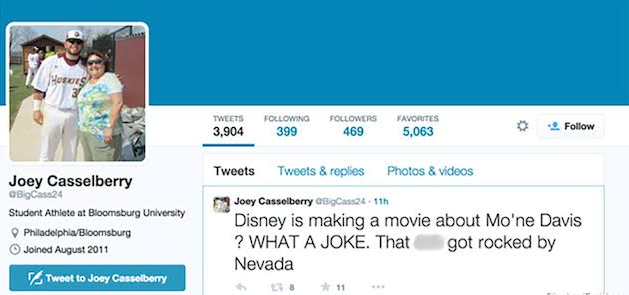
Another popular Twitter controversy has risen this past week. According to Sports Illustrated, a student-athlete at Bloomsburg University has been kicked off the baseball team after posting an insensitive tweet. Joey Casselberry, a sophomore baseball player posted the following tweet about Mo'ne Davis, a girl that has recently been publicized with success in the Little League World Series:


In the summer of 2014, 12 year old Mo'ne Davis became the first girl to pitch a shut out in the Little League World Series. Recently, the Disney Channel network that they will be producing "Throw Like Mo", an original movie about Davis' life as a baseball teen. Soon after the announcement of this movie, Joey Casselberry published his tweet that went viral quickly. The University took action immediately  and they also turned to Twitter to apologize to the public.


Despite being a star athlete on the baseball field, Mo'ne Davis hopes to play college and professional basketball. With these goals, she felt bad that Casselberry was revoked from the team. Davis and her coach actually emailed the University asking that Casselberry could be re-admitted on the team. She wrote,
"He made one dumb mistake. I'm sure he would go back and change it if he could. We all make mistakes and deserve to be forgiven. I hope you will give him a second chance and allow him to play."
The University has since state that they respect Davis's concern, but will support their previous decision and keep Joey Casselberry off the team.

In his public apology, Casselberry includes that his tweet is "an example that one stupid tweet can ruin someone's life.."

Friday, March 20, 2015

Social Media During March Madness

Who do we play? What's their record? Where are they from? What are they ranked? Who's their best player? 
These are all common questions during March Madness that can be answered literally at the tip of your finger. With the NCAA Tournament getting underway this weekend, social media conversations have sky rocketed. No longer do you have to tune into the television in hopes of catching details about your favorite team or players. People across the nation turn to their phone to search Google, Twitter, Facebook and many other sites to stay updated on what's happening in the college basketball world. Social media is all about current updates and can provide viewers with scores, stats, and predictions. According to the NCAA, 7.7 million social media comments were made about the tournament already. 88% of people use their cell phones to access March Madness information. .

This past week I traveled from Iowa to Florida. Throughout my trip, college basketball was a conversation I commonly overheard. I saw multiple people checking their phones and updating brackets. I even checked Twitter using a "Tweets in the Area" feature and saw that hundreds of people were constantly tweeting about the current games. Laying out on the beach, I was able to check Twitter to see what people were saying about games and who won through accounts like @SportsCenter and @NCAA. 

One of the coolest things about social media during March madness is connecting with the players. Going to a university that is currently in the dance, I've gotten to see first hand the interactions taking place. Fans wishing players luck and congratulating them on wins. Athletes tweeting back thanking their supporters and posting other words of determination and assurance to their fans that they're ready to play. All of which people wouldn't be able to see before social media.

Google Trends is an online feature to see what people are searching about. On the first day of March Madness, "NCAA Brackets" and "March Madness" we're #2 and #3 in the list of most searched on Google for the day with over 1 million searches each. 
Finally, Facebook generated a completed bracket solely based on social media mentions of teams and released it days before the tournament:


Friday, March 6, 2015

A Day in the Life: UNI Volleyball Player

After posting a few blogs about collegiate and professional athletes across the nation and how they are portrayed on social media, I thought I would change it up this week.

As a collegiate athlete myself, I also wanted to take the opportunity to use my blog as a platform to connect to friends, family, and fans. A lot of people only see college or professional athletes during games or through sports media, but they don't know what all goes on behind the scenes. For this blog, I'll be taking you through a few of my typical days.

The college volleyball season is typically the entire fall semester of school while off season workouts begin right after winter break and continue up until we start back up in August for the next season. This time of year we are focusing a lot of strength, conditioning, and mental focus to improve our game come fall.


Off-season day- March 5, 2015:
5:35 a.m.- I wake up to my alarm before the sun rises 3 days a week during the spring semester. I go through my daily morning routine before heading to the gym.
6:05 a.m.- For the next 1.5-2 hours the team and I work on a lot of body strength and technique. Our strength coach puts us through a variety of exercises or runs to work our muscles in different ways. These exercises include things like one-legged squats, uneven push-ups, hand-stands, and running stairs.
8:00 a.m.- After the workout, the team and I head to the cold tub to help our muscles recover. We then head back to our locker room to shower and get ready for our day.
9:45 a.m.- Back at home, I usually take some time to eat breakfast and catch up on some social media from the night before. I'll then have the opportunity to take a quick nap. Being an upperclassmen, I've been lucky to have a more flexible schedule that allows me to do this.
10:30 a.m.- I have sectioned off this hour and a half block to study and catch up on homework.
12:00 p.m.- I make myself a quick lunch and pack my bag for the rest of the afternoon
12:30-1:45 p.m.- Accounting class.
1:45 p.m.- From my class, I walk directly to the gym to quickly get ready for our team practice.


2:15-4:15 p.m.- Volleyball practice
4:30 p.m. - I head to the locker room to shower and if I have time, study a little before my class.
5:30 p.m.- 8:15 p.m. - Night class
8:30 p.m.- Back at home, I will make dinner and socialize with my roommates for awhile, update my social media for the day.
10:30 p.m.- I head to bed, as I have another early morning the next day

The days in the off season can get very long but they are rewarding. This time of year its fun to see your team grow together and accomplish things as a whole. Every day brings new challenges and every day is another opportunity to prepare for the upcoming season.


During the fall semester, our schedules are very different than during the off-season. This past fall, I had a busier class schedule and we did a lot of traveling.  Below, I'll take you through a typical Friday when we have a home game.

In-season day - A Typical Game Day:
8:00 a.m.- Wake up and do morning routine, eat breakfast
9:00-9:50 a.m. - Marketing class
10:00-10:50 a.m. - Accounting class (You can guess how hard it is to focus in back to back classes on game days!)
11:00 a.m. - noon - Study table (organized time that we turn our phones into the coach's office and strictly study for the amount of time scheduled that day)
12:15 p.m.- Back at home I'll make lunch and just relax for a couple hours.
3:00 p.m.- Start getting ready for the game and pack my bags and head to the gym
4:00 p.m. - Get to the locker room and hang out with teammates, some of us have to get pregame therapy such as ankle taping or stretching exercising in the training room.
5:00 p.m.- Watch film and go over scouting report of the other team
5:30 p.m.- Head to the court for a pre-warm up practice. We some basic things like serving, ball control, and going through each rotation's offense.
6:00 p.m.- Get pumped up for our match in the locker room with music and other routines
6:15 p.m. - Head out to the court to start our official warm-ups as the stands begin to fill with fans.
7:00 p.m. - The first serve marks the start of the match and we play best 3 out of 5
9:00 p.m. - We discuss how the match went, and head back out to talk with fans and family. Our trainers also suggest that we go to the cold tub to recover for another match the following day and then shower
9:30 p.m. - Most of us go out to eat with our parents at a restaurant in town so that we can spend time with our family while they are still in town.
10:30 p.m.- Lights out to get enough rest for Saturday's match.


One of the ways I like to use social media during the season is to promote our games. I have followers on my Twitter and Instagram sites that are UNI Volleyball fans. From classmates, friends, and even younger kids who have attended our games or camps. Instagram and Twitter have helped us players raise awareness about our home matches as well as creating a way to share some of my favorite pictures from out games.


Thursday, February 26, 2015

What NOT to Tweet

Last week's blog post was about two great examples of how athletes can use social media the "right" way. In this post, I wanted to look at the other side of social media.  As I was exploring the internet this week in hopes of finding a blog topic, I came across a quote that really stuck with me:

"What happens on social media stays on Google forever"

I read this statement over again a few times. What happens on social media stays on Google forever. As a student-athlete myself, I've had a few lectures on what kinds of things we should and shouldn't be posting online. In my head, I've always thought to myself "even if we were to post something bad on the internet, they would just ask us to take it down and that would be the end of it". Wrong. With technology today, for example, a tweet that was only posted for a single minute and then deleted can be screenshot and saved forever. Also, it doesn't matter if you're the star of your team, one of the worst people on your team, or not an athlete at all. Posting something negative can be saved and held against you in years later.

The best example I can use to show you how one tweet stuck with someone for years is the recently surfaced Cardale Jones of the Ohio State football team. Cardale Jones entered this past 2014 football season as a redshirt sophomore and was considered the Buckeye's 3rd string quaterback. Because of injuries, he made his first start at the end of the season in the Big 10 Championship Game. He led the team to a 59-0 victory and was named the MVP of the game. His second start of his college career came in the Allstate Sugar Bowl where he help his team beat #1 Alabama and advance to the National Championship. His third college start came in this championship where he let is team to yet another vicotry over the Oregon Ducks. Jones even considered entering the 2015 NFL draft but has recently decided to return to Ohio State next season.

While Cardale Jones had a lot of surprising success on the field in 2014 and 2015, the name Cardale Jones was being related to a different topic in the media. The buzz was about a tweet that Jones had sent out two years ago.

In 2012, Jones tweeted "Why should we have to go to class if we came here to play FOOTBALL, we ain't come to play SCHOOL classes are POINTLESS". At the time, Jones was 3rd on the depth chart and hadn't played a single down for the Buckeyes. Most people that hadn't followed him in high school didn't even know who we was yet. The tweet was taken down the same day but many media outlets had captured the tweet before it was gone. Jones was suspended for one game for his words.


While the tweet was posted two seasons ago, it was a hot topic from the commentators during this year's National Championship when they were discussing Jones' college journey. Luckily, Cardale Jones has learned form his mistakes. I currently follow Jones on twitter and his tweets are much more appropriate and entertaining now. His "bad" tweet was featured in a textbook at Ole Miss as an example for what not to do on social media sites and Jones has since commented and apologized for his actions. The lesson learned from this story: be careful with the content you provide the public because as soon as it's posted, it's out there for good. 


Wednesday, February 18, 2015

Iowa Grown: Harrison Barnes & Lolo Jones


This week I wanted to take some time to talk about some of the most influential athletes in my life. While I have a long personal list of athletes I look up to, I decided to talk about two of Iowa's own in this blog post, as I am also an Iowa native myself. Harrison Barnes and Lolo Jones are probably two of the most well-known names when it comes to athletics in the state of Iowa. For the few of you that don't know who these people are, here is a quick bit on each of them and how they relate to me:

Lolo Jones- Lolo Jones was born in Des Moines, Iowa and is considered one of the best American track and field athletes. She won 3 NCAA titles as well as several All-American honors while competing at LSU. She competed in several Summer Olympics but could never clinch the gold medal in her hurdles events. In 2014, she entered the Winter Olympics as a member on the USA Bobsled team in hopes of finally winning a gold medal. Pictured below is Lolo Jones competing in the 2011 Drake Relays held in Des Moines. While I didn't actually take the photo, I was in the same vicinity! My personal connection with Lolo Jones took place at the Drake relays because I also competed there several years in high school as a high jumper and got to watch Lolo compete first hand.


Harrison Barnes: Harrison Barnes was born in Ames, IA and is currently an NBA player for the Golden State Warriors. Barnes was a multi-sport athlete at Ames High School and was considered the #1 high school basketball player in the nation in 2010. He played college basketball as a University of North Caroline Tar Heel for two season before he entered the 2012 NBA draft. He was drafted as the #7 pick to the Warriors where he is still currently playing. My connection with Harrison Barnes comes from high school. Harrison Barnes played for Ames, which was in the same conference as Mason City, the school I went to (Go Mohawks!) so I got to watch Barnes compete every time he came to town. Pictured below is HB as a Warrior today and also HB competing in his last high school athletic event- the long jump which just so happened to also be at the Drake Relays in 2010. Clearly the Drake Relays brought many successful athletes together.


Besides their incredible commitment to their sports and success they've both had, I've realized that these are two athletes that I admire because I feel like I can connect with them. Both Harrison Barnes and Lolo Jones take time out of their day to show appreciation to their fans. Not only do they talk to their fans personally, they are both active users of their social media accounts. Many athletes today have turned to Twitter, Instagram, and Facebook to provide their fans with access into their personal lives outside of sports. People in today's society are interested in knowing what their favorite celebrities do in their spare time. These sites are also a great platform to promote charities, events, and products they are associated with.

One of the best uses of social media for popular athletic figures is connecting with their fans. In a recent Facebook article, Jones and Barnes were both named for being some of the most loyal Twitter users to their fans. In an interview, Jones explains that she loves replying to her fans and its usually at random times, like between sets of weight lifting. Periodically Barnes will announce that he will be having a Q&A.


This screenshot of one of Barnes' Q&A sessions on Facebook shows that he is committed to answering as many fans as possible, and you can see he has replied to every post in the comments!


Here are a few other posts that give us an inside look at their everyday life, and provide us more personal insight than any other media sources could provide.


Harrison Barnes uses Skype to verbally commit to UNC


Social media has become a common base for fans to connect with people they don't know personally. Television and news articles provide us with scores, stats, and basic updates of athletes but social media has helped take the step towards getting a better picture 'behind the scenes' in celebrities everyday lifestyles,

So if you haven't already, go ahead and click the follow button on the embedded tweets above, search their names on Instagram, or even like their pages on Facebook to  get a look at the daily life of these two incredible athletes that root back to Iowa. Who knows, maybe they'll even reply to one of your questions!

Thursday, February 5, 2015

Super Bowl Social Media


Last weekend was one of the most celebrated sports days in America. Whether or not your favorite team was playing in Super Bowl 2015 (sad Packers fan here), I'm guessing many of you tuned in to the game at some point on Sunday. Other than the game, many viewers were interested in catching the latest commercials, as Super Bowl Sunday usually provides some of the best commercials of the year. Following my twitter account and searching different hashtags about the game and the commercials almost provided more entertainment than the game itself.


One of the commercials that caught my attention the most was the Nationwide commercial during one of the timeouts of the game. As I was on Twitter, I found that I wasn't the only one that was caught off guard with the message being portrayed by this popular insurance company. If you missed the commercial, go ahead and take a minute to watch it here:


Here were some of the tweets that followed it:


So why would Nationwide go through with publicizing this risky ad? The reason big companies like Nationwide pay big money (the 2015 rate was about $9 million per minute) during the Super Bowl is to connect with the sports fans. Companies know football is one of the biggest entertainment providers today so they took this opportunity to reach out to these football fans and catch their attention and inform them about what their company has to offer. These viewers then turn to social media where they can discuss and connect with other fans. The point of the eerie commercial was to get people talking, to get their name out there, and to create awareness of their product. Social media created a great platform for this goal.

The following was released a few days after the ad and provides a great explanation for why the company did what they did and shows just how effective social media's role was in spreading the word.

Nationwide created a lot of attention and got the audience talking. They met their goal of getting a reaction from the people. If you heard anyone talking about the Nationwide commercial, or any other commercial aired during the game (that Budweiser puppy is always a crowd fav), than the company succeeded. After this year, I am anxious to see what the marketing department for Nationwide comes up with for Super Bowl 2016!